Author name: tom

More on a bad idea

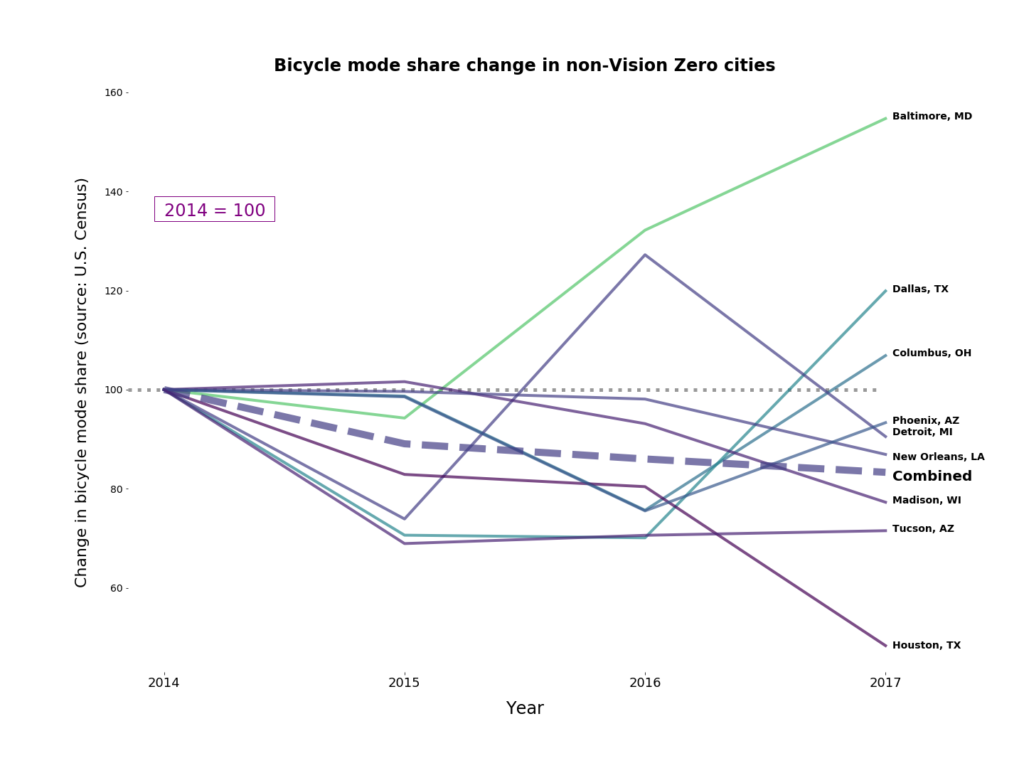
My post on Vision Zero’s threat amplification communications strategy got some interesting responses. One class of response as a sigh of relief, from advocates and city officials who don’t want to adopt such a confrontational style. Another was an interest in comparison data; what happened in non-Vision Zero cities over the same time frames? An entirely reasonable question, and easy for me to research.

Changing the conversation: A bad idea?

In streets advocacy, I think we have two core goals: Reducing auto trips, and increasing safety. When we consider our tactics, we should consider how they will advance that strategy. The advocacy response to the recent death of Tess Rothstein in San Francisco raised a concern that’s been troubling me for some time; our rhetoric around street safety has become increasingly hyperbolic and strident. What if “Interested but Concerned” cyclists might be scared away by repeated messages about life safety risks? What if changing the conversation is a bad idea?

Bike women

For a Twitter thread on International Women’s Day, I was reflecting on how many of the people who’ve inspired my work are women. I thought they deserved a more substantial post here, so, here are some shout outs.

BlackSpace Manifesto

Deep listening

Two somewhat related items came across my feed recently which got me thinking about our responsibilities as planners in listening to disadvantaged communities. One is a study about how urban cycling investments “focus on the needs of wealthy riders and neglect lower-income residents and people of color.” The other is the BlackSpace Manifesto, a statement of principles by a group of Black planners and activists.

Three maps, showing non-white population in Oakland along International, MacArthur, and Skyline Boulevards.

MLK Way: Conclusion

The biggest lesson I take from this project is that urban Black communities (and disadvantaged communities in general) have complex challenges, and those of us who care about equity and social justice need to grapple with that complexity. “Gentrification” is a reductive term which avoids meaningful engagement. While all of this is definitely Black History, it’s also White history. Those of us who believe in social justice as a concept, and who have benefitted from racist policies advantaging us and our families, need to learn to participate in social justice as a practice.

Scatter plot, displaying a correlation between increase in White population and increase in income

MLK Way part 9: Summary data

If you prefer charts to maps, here’s the post you’ve been waiting for; aggregate data for all 58 study cities, with bar charts, scatter plots, sums, medians and correlations. Woot! Interestingly, a number of my field work cities show up prominently in the data.

Scroll to Top